How to Successfully Outsource Work from The USA to India?
Pranay Agrawal | October 8, 2025 , 24 min read
Table Of Content
India is at the heart of the 21st century’s innovative impulse. The hardworking, smart and ambitious youth of India is leading the way to the technological advances in the country. With entrepreneurship taking the flight, India promises soaring expansion.
This can be estimated by the ever growing presence of Global Capability Centers, with more than 55% of the world’s GCCs established in India itself. Companies such as Microsoft, Adobe, Allstate India (USA), Ernst & Young Global Limited and the likes have opened up their own GCCs in India, this reflects the solid foundation India offers.
In addition, the Indian Government supporting the economic and technological growth by providing required infrastructure like Digital public Infrastructure through India stack and policy level support, encourages the ambitious. In this scheme of things, India has become a preferred outsourcing destination.
Read on to know how to outsource work from the USA to India.
Key Takeaways
- India offers a vast, skilled talent pool with over 1.3 million engineers graduating annually, making it an ideal outsourcing destination for tech work.
- Did you know? Almost 59% of the US based businesses outsourcing its tech needs to India, and 22% are planning to.
- Outsourcing to India delivers significant cost savings, with businesses enjoying up to 60% reductions in operational expenses.
- India’s time zone advantage enables round-the-clock operations, accelerating project timelines and improving service availability.
The Growing Trend of Outsourcing to India
- The Growing Trend of Outsourcing to India
- Step-by-Step Guide: How to Outsource Work from the USA to India
- Why Consider Outsourcing Work From the USA to India?
- 5 Best Practices for Outsourcing to India
- Common Challenges When Outsourcing (And How to Overcome Them)
- Legal and Compliance Considerations for Outsourcing to India
- Cost Considerations While Outsourcing Work To India From The USA
- 4 Best Models of Outsourcing
- Top Services that Can be Outsourced to India
- Case Studies and Success Stories from the corners of ScaleupAlly
- Wrapping Up
- Frequently Asked Questions
India has set the trend as preferred outsourcing destination for business processes, e-publishing, data processing, business process outsourcing, ecommerce management, search engine marketing, knowledge processes outsourcing, and more. It offers unmatched cost effective solutions with faster turnaround time.
Post Covid’19, the way companies work have changed, now the flexibility for hybrid model and openness to work from home becoming the new work cultural hat.
In a latest survey done by Deloitte, study reveals that India is at the forefront of outsourcing destination, with almost 59% of the businesses outsourcing its tech needs to India, and 22% are planning to.
All thanks to India’s cheaper internet accessibility, skilled professionals, and supported virtual working models.
Overview of the Growing Trend of Outsourcing to India:
- Huge Talent Pool: The highest population of around 4,500,000 with skills in high end developing tech as compared to all other countries makes it more appealing in terms of cost arbitrage and quality of work. This also allows businesses to easily scale their business processes, as the talent is in abundance.
- Negligible Language Barrier: The other added benefit is good acquaintance with English for easy communication. This makes it easier for the companies to have clear communication about the vision and needs, enabling regular updates as a result.
- Welcoming Attitudes: Another one is the humble nature of the Indian population, creates a favourable environment to engage in.
- Time Zone: India is geographically placed in a time zone where it covers various countries, saving time from unnecessary time lags.
- Stable Government: As world largest democracy, with regular elections, stable government, and vibrant culture, all makes India a thriving place to be partnering with.
What do stats say?
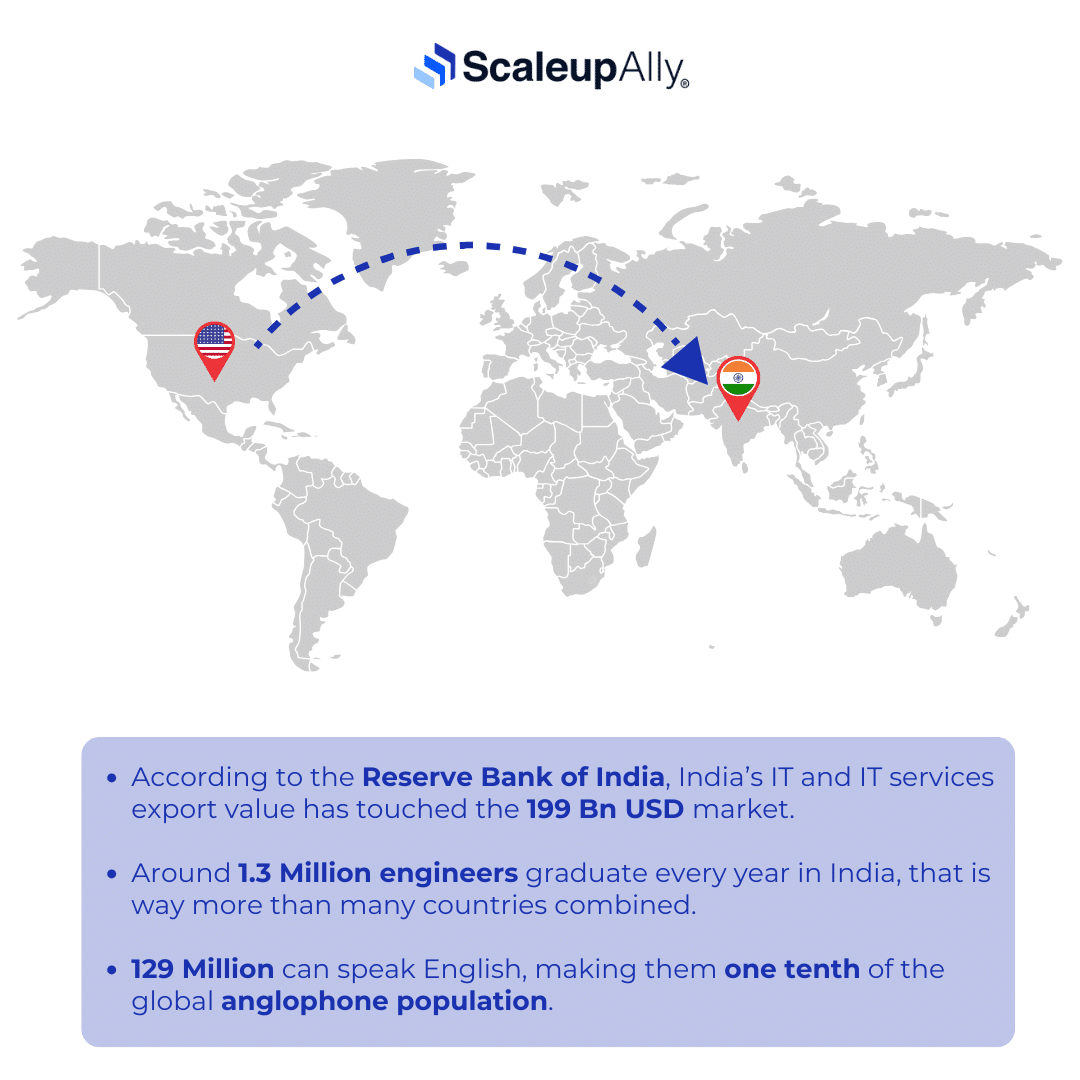
- According to the Reserve Bank of India, India’s IT and IT services export value has touched the 199 Bn USD market.
- Around 1.3 Million engineers graduate every year in India, that is way more than many countries combined.
- 129 Million can speak English, making them one tenth of the global anglophone population.
Also Read: 12 Reasons Why IT Outsourcing To India Is The Best Decision
Step-by-Step Guide: How to Outsource Work from the USA to India
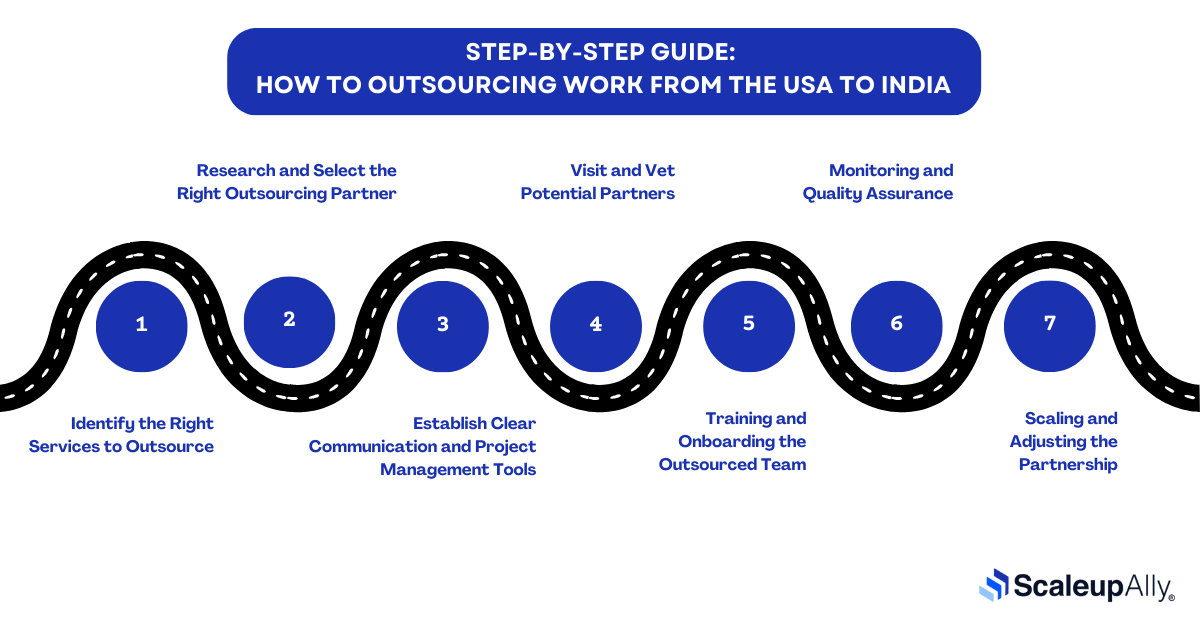
STEP 1: Identify the Right Services to Outsource
The first step in outsourcing work from the USA to India is to start identifying the tasks one wants to outsource, like web development, customer support, segment development, tech support, software development, data entry, digital marketing, business intelligence, etc.
Then you identify whether the task can be delegated virtually where your physical presence is not demanded. Meanwhile, do a complexity analysis of your tasks, this will narrow down your research. Once this is done, you will be ready to proceed to decide what best aligns with your business strategy.
STEP 2: Research and Select the Right Outsourcing Partner
Now, your work starts from here. It is important to know in detail about the outsourcing options. Begin with researching the geographical location best suited for you, then research who are the ones who may provide you the desired quality of work within the stipulated timeline.
Analyze each provider in terms of Quality, Proof of Work, Industry Expertise, Reputation, Technical Capabilities, legal and Security Compliance, and last but not the least, have a word with their clients to gain insights. Finalize the list, and connect with them.
For example, in India, you can look for cost arbitrage as a favourable reason in choosing the right outsourcing partner.
STEP 3: Establish Clear Communication and Project Management Tools
Next step is to define communication protocols, which may include communication channels like Slack, Emails, Zoom; and set response timeline, escalation paths. Employ project management tools like Trello, Asana, Jira to track progress.
Now comes the part where you need to set clear expectations, deadlines, parameters of KPIs, this way you will be in command of your outsourced project scope from the very start, and the provider will be in better synergy with you.
STEP 4: Visit and Vet Potential Partners
If it’s doable, do visit your shortlisted providers personally, for this will give you the opportunity to lay the foundation to a good start with a solid relationship and will allow you to vet their operations firsthand.
Benefits?
On-site evaluation for a glimpse into their working environment, infrastructure, security measures, etc. Chances of building the rapport, assess scalability if needed.
STEP 5: Training and Onboarding the Outsourced Team
Once the outsourcing partner has been finalized, now comes the assimilation part. With clear SoPs in place, training and onboarding the team makes a big difference. Process documentation, workflows, etc.
Decide the core team members, devise a training programme to set the tone, which then be deployed by the core team to the remaining team members.
This builds smoother transition, and better synergy amongst all. The on site, off site models or the combination of both can be adopted, with regular check-ins and feedback.
STEP 6: Monitoring and Quality Assurance
For this, you need to have performance metrics defined. Correct KPIs for turnaround time, errors, consumer responses, tracking of the other measurements related to business strategy. Regular audits to check whether the team meets the quality standards and delivery status.
Feedback loops for errors, issues and any other bottlenecks for improvements. This way, the quality sits at the front seat.
STEP 7: Scaling and Adjusting the Partnership
This the last leg of the lot. The checklist has been ticked off, and the partnership has gained some grounds of trust and smoother workflow.This is where the future growth strategy enters.
Discussion on the team size, services, or even aims of entering new markets.
As the business grows, adjusting processes like communication protocols, SLAs, workflows as per the business’s objectives. This is where the long term relationship builds up for further collaboration.
How Can US Companies Benefit from India?
Learn how outsourcing improves productivity, reduces costs, and scales operations efficiently.

Why Consider Outsourcing Work From the USA to India?
Businesses around the world are choosing India for outsourcing its tech needs. Let us find out what makes India stand out and why US companies are outsourcing projects to India.
1. Skilled Workforce
In a study by Statista, India scored highest in People Skills and Availability scorecard with 2.18, firmly establishing it as a skilled powerhouse. It also revealed that Indian developer’s hourly rates are as low as 20 USD to 40 USD.
Since, India surpassed China in terms of population, and is one the youngest countries in the world, with 65% of the population is under the age of 35 years, and around 37.4 million enrolled in higher education like technology, innovation, engineering, core sciences, business, commerce etc.
Around 1.3 million engineers graduate every year. The country has a strong global reputation for excellence in fields like data engineering, analytics, financial services, software development, etc.
Now, there are multiple options with respect to outsourcing work, models like SDaaS, TaaS, or independent freelancing engagement, with elaborated SoPs and strong team management in place. The abundance of skilled workforce in India makes it a go-to option when it comes to outsourcing tech work.
2. Cost Efficiency
One of the most compelling reasons to outsource to India is the significant cost savings. India offers highly competitive pricing for services, mainly due to the lower cost of living compared to Western countries.
This allows companies to access high-quality services at a fraction of the cost they would incur in their home countries.
For example, outsourcing software development or customer support to India can result in savings of 50-60%.
Additionally, many Indian outsourcing providers offer flexible pricing models, such as fixed-cost or hourly rates, further improving cost management for businesses.
3. Quality and Reliability
Indian outsourcing providers have built a reputation for delivering high-quality services. Many of them are certified under global standards such as ISO and CMMI, guaranteeing consistent delivery of top-notch services.
Over the years, India’s outsourcing industry has evolved to be more professionally sound, with increased focus on quality.
Companies outsourcing to India can expect a strong adherence to deadlines, service-level agreements (SLAs), and excellent quality control measures. Moreover, many Indian outsourcing partners provide reliable customer support and 24/7 services.
4. Time Zone Advantage
India’s geographical placement offers another strategic benefit, that is a viable time zone, especially for businesses outsourcing from the US, Europe, or other regions. India is typically 9 to 12 hours ahead of the US, allowing for round-the-clock operations.
This advantage allows businesses to have their tasks completed overnight, accelerating project timelines. Also critical functions like customer support or technical maintenance are available 24/7.
5. Technological Expertise
India’s technological ecosystem is well-developed, with strong expertise in IT, software development, data analytics, and emerging technologies like artificial intelligence, machine learning, and blockchain.
The country is home to numerous IT hubs, such as Noida, Bangalore, Hyderabad, and Pune, which host global leaders in technology. With robust digital infrastructure, and ever churning entrepreneurial wheel, India is a hot spot for techies around the world and hence many US companies are looking for outsourcing partners in India.
5 Best Practices for Outsourcing to India
If you’re looking for an outsourcing partner, this section outlines the best practices for successfully outsourcing to India.
1. Thorough Partner Research
Conduct your in depth research on their track record, client testimonials, industry expertise, and certifications. Also, verify their experience with similar projects, scalability, and most importantly have some knowledge of their financial stability. Verify their capabilities, reliability via reference checks and case studies.
2. Clear and Detailed Contracts
Once you are clear of what you are expecting, draft a very clear and detailed engagement contract about the scope of work, deliverables, expected timeline, KPIs, clauses for any changes during the course of the engagement, terms of confidentiality, IP rights, etc. Also establish dispute resolution mechanisms and other terms & conditions to prevent any unforeseen issues.
3. Regular Updates and Communication
Establish a regular communication schedule to track project progress and address any issues promptly. Use various tools like video conferencing, project management software, and regular status reports to maintain transparency. This has been discussed in detail in the above section.
4. Cultural Sensitivity
Since India is a multicultural country, one may find diverse cultural imprints. Almost 1721 languages are spoken here, and hence to outsource work to India demands the understanding and respect of cultural differences for a positive working relationship. This also reflects the Indian population’s ability to accommodate different cultures and to be able to maintain harmony.
5. Data Security
Study the country’s laws and regulations regarding intellectual property and other related rights, how the judiciary resolves such issues if it arises. Know about the data security protocols and security measurements for the technologies. Make sure that your chosen partner abides by global data protection standards and cybersecurity.

Common Challenges When Outsourcing (And How to Overcome Them)
While outsourcing to India offers immense advantages, it’s essential to acknowledge the common challenges businesses may face—especially for first-time outsourcing teams. Being aware of these hurdles helps prepare better outsourcing strategies.
1. Time Zone Misalignment
Despite the time zone advantage for 24/7 operations, scheduling real-time meetings or managing collaborative tasks can be difficult without planned overlap hours.
Solution:
Define overlapping working hours upfront, and schedule recurring sync meetings to ensure alignment.
2. Communication Barriers
While most Indian professionals are proficient in English, differences in communication styles, accents, or expectations may lead to misunderstandings.
Solution:
Invest in regular video calls, shared documentation, and clear communication protocols using tools like Slack or Confluence.
3. Quality Control Concerns
Initial output may sometimes miss the mark due to gaps in understanding business goals, standards, or market nuances.
Solution:
Set clear KPIs, provide reference benchmarks, and conduct regular quality audits and feedback cycles.
4. Data Security & Compliance Risks
Depending on the nature of work, concerns may arise around data access, handling of sensitive customer information, or regulatory compliance (e.g., GDPR, HIPAA).
Solution:
Ensure your outsourcing partner complies with global data protection standards and sign robust NDAs and SLAs.
5. Cultural Differences
Differing work cultures—such as attitudes toward hierarchy, timelines, or assertiveness—can affect collaboration.
Solution:
Encourage cultural sensitivity on both sides and foster an open, respectful feedback environment.
6. Overdependence on a Single Vendor
Relying too heavily on one outsourcing partner may increase vulnerability to delays, bottlenecks, or quality dips.
Solution:
Create fallback options and consider a multi-vendor strategy or phased engagement with performance clauses.
Legal and Compliance Considerations for Outsourcing to India
Outsourcing operations to India can be a strategic move, offering significant cost savings and access to skilled talent. However, for U.S.-based companies, navigating the legal and compliance landscape is crucial. Taking the right precautions can protect your business, minimize risk, and ensure long-term success. Here’s what you should keep in mind:
1. Data Protection and Privacy Laws
Global Compliance: If your outsourcing project involves handling sensitive customer information, make sure your Indian partner is fully compliant with global data privacy standards like the EU’s General Data Protection Regulation (GDPR) and the U.S. Health Insurance Portability and Accountability Act (HIPAA), depending on your industry.
Indian Data Laws: India regulates digital data under the Information Technology Act of 2000, and more recently, the Digital Personal Data Protection Act (DPDP) of 2023. These laws establish clear rules around how personal data is stored, used, and shared—particularly with respect to cross-border transfers and user consent.
Recommended Action: Always include detailed Data Processing Agreements (DPAs) in your contracts. These should outline how data will be collected, used, protected, and deleted.
2. Intellectual Property (IP) Protection
Clear Ownership Terms: Avoid any ambiguity around who owns the work being produced. Your contracts should make it explicit that all IP—including software code, designs, and documentation—belongs to your company.
Essential Agreements: Require outsourcing vendors to sign Non-Disclosure Agreements (NDAs) and include IP Assignment Clauses to protect sensitive business information and innovations.
Legal Alignment: Make sure your agreements respect both U.S. and Indian intellectual property laws to prevent future legal complications.
3. Contracts and Service-Level Agreements (SLAs)
Define the Scope: Spell out exactly what you expect—deliverables, deadlines, and who’s responsible for what. Clarity is key.
Set Performance Standards: Use Key Performance Indicators (KPIs) and SLAs to track outcomes, and include penalties for underperformance if necessary.
Handle Disputes Smartly: Decide upfront how you’ll resolve conflicts. Many companies opt for arbitration in neutral countries like Singapore or the U.K., though you can choose to govern the contract under U.S. or Indian law.
4. Taxation and Payment Rules
Avoid Double Taxation: The U.S.-India Double Taxation Avoidance Agreement (DTAA) helps businesses avoid being taxed on the same income in both countries.
Transfer Pricing Compliance: For large contracts, ensure your pricing structure meets international transfer pricing laws to avoid audits or fines.
Currency and Payment Terms: Clarify payment timelines, the currency (USD or INR), and how you’ll handle foreign exchange fluctuations.
5. Industry Compliance Requirements
Security Certifications: Verify that your outsourcing provider holds reputable certifications such as ISO 27001, SOC 2, or CMMI, which indicate a mature approach to information security and quality.
Industry-Specific Rules: If you work in a regulated industry—like healthcare, finance, or e-commerce—ensure your partner complies with relevant standards such as HIPAA, PCI DSS, or similar frameworks.
6. Labor and Employment Regulations
Outsourcing firms in India must follow local labor laws related to wages, benefits, and workplace conditions. While you’re not directly employing their staff, it’s important to ensure your outsourcing partner adheres to these laws. Failing to do so can create reputational and even legal risks for your business.
Cost Considerations While Outsourcing Work To India From The USA
One of the key decision parameters is budgeting in any business set up, and in this section we will explore cost considerations when you outsource work to India.
- Labour Cost: Since the living expenses are less in India as compared to the USA, the cuts down the labour expenses as well. As a result, India becomes more pocket friendly and approachable.
- Diverse Services: Many Indian firms offer multiple services like Gen AI integration, to data engineering, to data analytics, business intelligence, operational processes, management, software development, cloud computing, etc. India already holds a good footprint of customer support in the US, and now expanding in Latin America as well. This allows companies to outsource both the tech support as well as customer support with much ease.
- Infrastructure Cost: These firms often bear the cost of physical infrastructure like office space, technology, and other utilities, which reduced the expenses for US based companies by 60-70%.
- Contract and Services Fees: These are defined SLAs (Service level agreements) for various operational fees such as set up fees, services fees etc. This ensures the clarity of budget and gives you an overview of the estimated costs one might incur if decides to move forward. Saves from unanticipated expenses.
- Exchange Rates: The conversion rate between US dollar and Indian rupee, goes in the USA’s favour. Even after market fluctuations, it favours the former. Although volatility lurks around, it is also important to take the potential changes which might affect the long term estimations of the budget.
- Training and Onboarding: Since, models like SDaaS and TaaS are maturing, with clearly defined engagement rules and services, these have added benefits. Benefit of not getting entangled into the perpetual hiring, onboarding, training cycle. The entire process and chaos is handled by these firms who offers such services.
- Travel and Communication Costs: If need be, the personal visits, online conferences, and regular meets up may add to the expense list, and should be considered while outsourcing the work.
4 Best Models of Outsourcing
1. Offshore Outsourcing
Offshore outsourcing involves contracting business processes or services to a company or contractor located in a distant country, often one with lower labor costs.
Key Characteristics:
- Cost savings: Reduces operational costs, particularly labor costs.
- Offshore outsourcing allows companies to tap into specialized expertise and a larger talent pool available in other countries.
- Time zone advantage: Companies can take advantage of different time zones to have work done around the clock (e.g., a U.S. company outsourcing to India can have developers working overnight while U.S. teams rest).\
Also Read: How to Set Up an Offshore Team in India?
2. Nearshore Outsourcing
Nearshore outsourcing is the practice of outsourcing services to companies in nearby countries, usually within the same or similar time zone.
Key Characteristics:
- Geographic proximity
- Cultural and language similarities
- Minimal time zone differences between the client and the outsourced team, making real-time communication easier.
3. Onshore (Domestic) Outsourcing
Onshore outsourcing is when a company contracts services or processes to a provider within the same country, but often in a different geographic region.
Key Characteristics:
- Same country: The outsourced work stays within the same country or even the same state.
- Local regulations: Onshore outsourcing avoids some of the legal, regulatory, and tax complexities that can come with offshore or nearshore outsourcing.
- Easier collaboration: Since the teams are in the same country, cultural and language differences are minimized.
4. Staff Augmentation
Staff augmentation involves hiring temporary or contract-based staff to fill in skill gaps within a company’s existing workforce, rather than outsourcing entire processes or functions.
Key Characteristics:
- Scalability and flexible workforce
- Provides access to specialized skills without the long-term commitment of hiring full-time employees.
- Unlike traditional outsourcing, businesses maintain direct control over the augmented staff, and they work as part of the internal team.
Top Services that Can be Outsourced to India
As we now know, India is a leading outsourcing hub, best known for its top notch, hard working skilled professionals. The added benefit is its positioning as a cost effective talent access.
Because of this, companies in the US commonly prefer to outsource the following services to India:
- IT and software development
- Customer support
- BPO (business process outsourcing)
- Financial and accounting services
- Legal process outsourcing (LPO)
- Content writing
- Digital marketing
- Engineering and design services
- Human resources outsourcing.
Additionally, research and development, translation and localization, sales and lead generation, and video and animation services are increasingly outsourced to India.
With its diverse offerings, India remains a top choice for global businesses seeking quality, affordability, and expertise.
Case Studies and Success Stories from the corners of ScaleupAlly
1. Strata
Strata Markets is a leading independent provider of almond price indexes, almond prices, and market news and analysis for the global almond market. With a mission to empower their clients with data-driven insights, they sought to streamline their data reporting and analysis process.
They embarked on a Business Intelligence (BI) project to consolidate and visualize their data related to daily price indications, monthly shipments, and market trends. We joined hands with them for their BI project and successfully delivered it.
2. Patriot Environmental Services
Patriot Environmental Services is a leading provider of comprehensive environmental, waste, and national response services, offering round-the-clock support to customers and industries across various sectors.
Recognizing the importance of data-driven decision-making, Patriot Environmental initiated a Business Intelligence (BI) project with ScaleupAlly to centralize and analyze data from multiple sources, including AWS SQL, Excel, and their Enterprise Resource Planning (ERP) system.
The goal was to generate reports related to Finance & Accounting performance and Employee Performance.
Wrapping Up
India continues to be a global leader in outsourcing, offering a perfect blend of cost savings, technical expertise, and a massive talent pool. From IT and software development to customer support and financial services, businesses across industries are leveraging India’s capabilities to scale operations efficiently.
If you’re considering outsourcing to India from the USA, remember these key insights:
✅ Identify the right services and outsourcing model that align with your business goals.
✅ Choose a reputable outsourcing partner with proven expertise and strong security measures.
✅ Establish clear communication protocols and use project management tools for seamless collaboration.
✅ Implement a structured onboarding process to integrate the outsourced team effectively.
✅ Continuously monitor quality, performance, and compliance to ensure long-term success.
With strategic planning and the right approach, US outsourcing to India can open up new growth opportunities for your business while significantly reducing operational costs.
Frequently Asked Questions
Q: Is outsourcing to India a good idea?
A big Yes! Skilled workforce, great cost arbitrage, and strong communications places India as a favourable and viable option for outsourcing work.
Q: What are the most common services outsourced to India?
Most common services are data engineering, data analytics, business intelligence, operational processes, management, software development, cloud computing, customer support etc.
Q: How do I protect my intellectual property when outsourcing?
Make sure that your partner adheres to global standards of intellectual property protection, and strictly follows its country’s compliances. Before moving ahead with the engagement, make sure that both the parties have clearly defined who owns the copyrights, trademark, patents (if any). There has to be confidentiality with respect to the trade secrets or any unique business feature which gives you that competitive edge, this must be strictly defined under the Non Disclosure Agreement.
Q: What are some jobs the US is outsourcing to India?
U.S. companies that are outsourcing some jobs to India are related to IT development, customer support, software engineering, data entry, finance and accounting, technical support, content writing, telemarketing, and legal process outsourcing (LPO).
References:

Related Blogs
Nearshoring vs. Offshoring vs. Onshoring: Key Differences
Discover the key differences between nearshoring, offshoring, and onshoring. Learn the benefits, challenges, and how to choose the best outsourcing strategy for your business.
webadmin
Feb 13 ,
6 min read

Top 20 Emerging Technologies of 2026
Discover the top 20 emerging technologies of 2026. Explore which innovations are driving change across healthcare, finance, manufacturing, and other crucial industries.
ScaleupAlly Team
Dec 16 ,
9 min read
IT Outsourcing Costs Explained: Global Rates, Key Influencers & Cost-Saving Tips
Discover what IT outsourcing costs include, key pricing factors, hidden fees, regional rates, and how to pick a cost-effective outsourcing partner.
Pranay Agrawal
Nov 29 ,
13 min read